Six years ago, the UN launched the Programme on Governance in the Arab Region (POGAR). POGAR was developed at the request of Arab governments to improve government practices in the region. POGAR works in partnership with legislative and judicial institutions as well as civil society to identify problems and solutions and provide training.
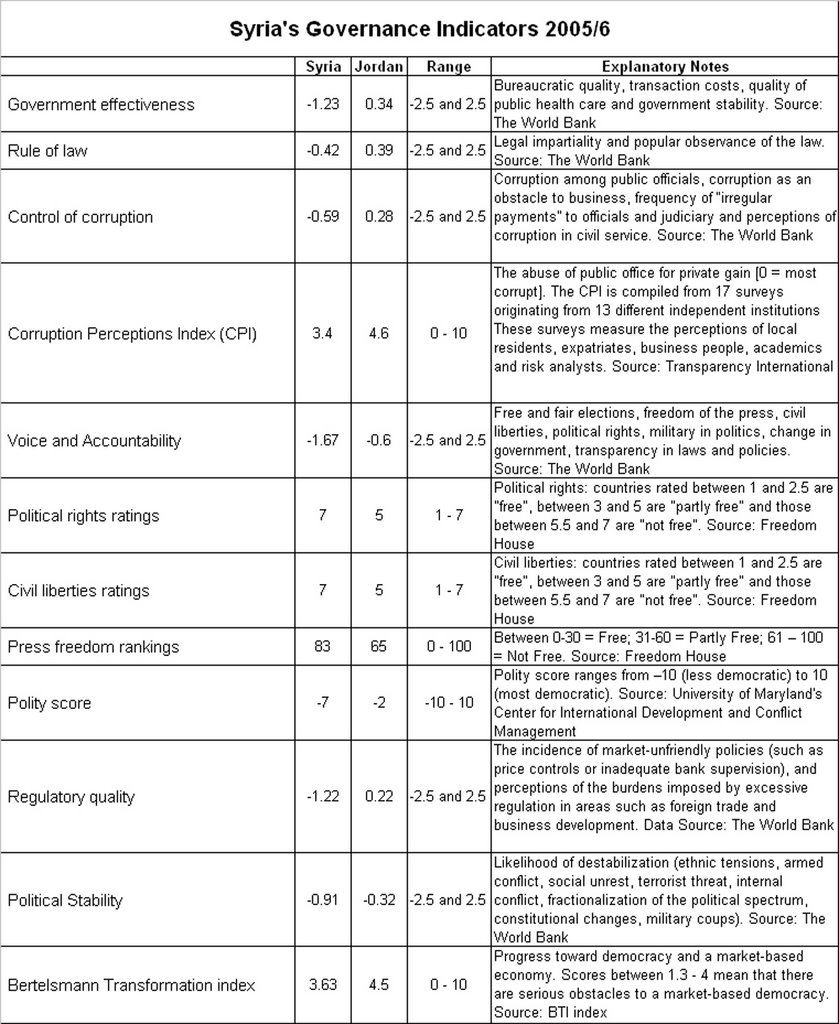
Syria's governance, by international and Arab standards, remains very poor. There has been a slight improvement in the fight against corruption and liberalising the economy. However, on most key indicators, governance standards have deteriorated since the launch of the programme and appointment of Bashar Al Assad as President. The table below provides a summary of Syria's position both internationally and relative to neighbouring Jordan's (click on image to enlarge).
Jordan is a monarchy where the King enjoys fabulous wealth and wide constitutional powers. Syria is a dictatorship where the President enjoys fabulous wealth and wide constitutional and unconstitutional powers. Their populations know that both "hereditary" systems are corrupt and unfair, but it is a question of degree and intent. With such control, both King and President can make things happen. The King, and his father before him, have managed to put their country on the path of democracy and reform and make albeit modest but real progress. The President, and his father before him, have never been able to move the country decisively forward on political or economic reforms. Why? The main reasons are foreign policy adventutrism and almost unrivalled civillian administrative incompetence.
There is no sign that Syria's rulers are about to refocus their energies on domestic issues that matter most to the lives of ordinary people. Day by day, they continue to destabilise the social and legal foundations of the state, corrupt its institutions and distort its economy. As the old adage goes: absolute power corrupts absolutely; Syria sadly remains the living example of this.